
The AI Response Spectrum
How are you reacting to the GenAI revolution?

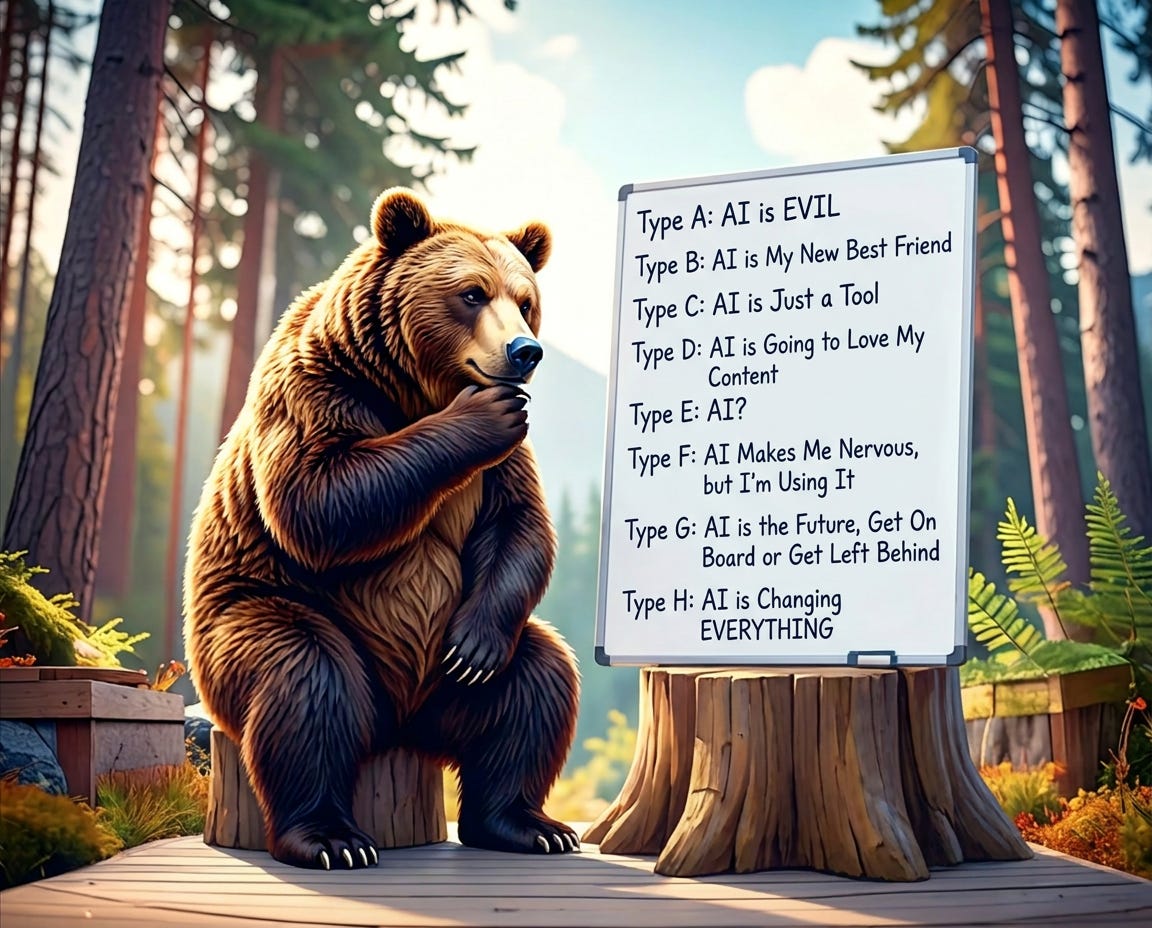
I’ve been thinking a lot about generative AI lately. How can you not? I’m in shock when any discussion with someone longer than fifteen minutes does not involve a tangent into AI. We especially like to share some jaw-dropping cool applications, or when AI was just wrong. There is a lot of nervous laughter. Like when a new employee is really good at their job, but everyone knows they keep a large ax in the passenger seat of their car. We want to talk about how helpful they are, but also… the ax!
And that is what I’ve been thinking about a lot lately, how we react. Like any important change in human society, the human response is all over the place — not just between different people but often within the same person. If we are going to end up on the positive side of this transformation, we need to be open and honest about our emotional response to all of it. For some reason, my brain likes to put things into categories when I’m trying to figure stuff out.
Eric’s AI Response Stereotypes
So, I’ve been dealing with the AI revolution by classifying people’s responses. It’s kind of fun, and it keeps me from thinking about the real implications of Large Language Models (LLMs) on our species.
Type A: AI is EVIL
These people are easy to spot because they will bring up a long list of environmental, mental, economic, and geopolitical reasons why your asking Claude to explain the difference between “respond” and “react” is an existential threat. It is more than having an issue with AI, they have turned it into an object of derision and hate, throwing any real and logical understanding of what is going on right out the window. The big problem with Type A people is that we all fear they may be right.
Type B: AI is My New Best Friend
This is the biggest surprise to me. We read about it in the paper and sometimes run into people. It starts with anthropomorphizing their preferred chat tool, often giving it a cute name. Then you find out they ask it for advice all the time and that they take the advice. I’ve even seen people spiral into a bad mood because their chat buddy “Rudolpho” criticized them. At best, Type B responses can provide people with a tool that provides them with support and confidence. At worst, they use it to replace the human interaction they need, including friendship and love, and spiral into isolation that can amplify existing mental health issues.
Type C: AI is Just a Tool
This is the most practical and least disruptive way to respond to the LLM-induced transformation going on around us. If you are in this category, you learn what it is good at, what it is bad at, and start using it where it can be helpful. You don’t rely on it too much, but you find it handy. A Type C response is comforting and has a low emotional investment. It may also be somewhat delusional. This is a lot more than just a tool.
Type D: AI is Going to Love My Content
Generative AI is scraping the digital world and training itself on existing content. So the best way to push back the fear around a very uncertain future is to try to get some control over it. And telling yourself that you are creating that content that AI feeds off of is a good way to feel some amount of human autonomy. I often take refuge in a Type D response by asking Gemini a question I know I‘ve written about and rejoicing when I see my content in the source links for the response. It’s like adding a glass of water to the ocean, but it is comforting to see my own digital contribution.
Type E: AI?
One very effective response is to push it out and just stay ignorant of the whole thing. Living without AI-induced anxiety is a pretty attractive reaction. We all really do need to ask ourselves whether we should be jumping into the white water of technological and social upheaval, or whether it is better to use a Type E response, turn the music up, and walk downstream to see what it looks like when things calm down. Or, just like the powers that be have made watching the news unbearable, pushing people to disengage, is putting our head in the sand exactly what “they” want us to do?
Type F: AI Makes Me Nervous, but I’m Using It
Using these AI tools with a little bit of trepidation may be the healthiest response. It keeps us involved and benefiting from the power this technology delivers, while giving us an emotional buffer of caution. Also, if things do go south and you find yourself being corralled by a gun-wielding robot, you can find comfort in telling yourself that you were nervous when we started sliding down the slippery slope.
Type G: AI is the Future, Get On Board or Get Left Behind
This is another fear-based response. Not that those gun-wielding robots will show up, but that if you take a more laissez-faire approach to AI, your job and maybe your ability to compete will be removed. There is also some greed involved in this way of reacting, because a lot of money is being made on providing AI tools or using them in new and powerful ways. No one really likes being picked last for the team, and the Type G response pushes us to get good enough with these tools to stay on the field and not end up on the bench.
Type H: AI is Changing EVERYTHING
Every technological upheaval has its true believers. There is a certain crazed intensity in their eyes when they talk about their Mac Mini cluster running OpenClaw to do their shopping, manage their Hinge account, day trade, and optimize their nutraceutical intake. Just like Type A response people, Type H people will use any excuse whatsoever to bring up AI. We may also fear that they are the ones getting it right.
Where are You On the Spectrum?
If I’m honest, I want to be Type F, usage with some hesitation. And for me, the nervousness is not so much because a future catastrophe is coming. My caution comes from not knowing what is coming next. This revolution is happening so fast, we are all just guessing at how things will really change.
But I bounce all over the place based on my mood that day or who I talked to last. I like to take refuge in Type D, imagining how this very article will be tokenized and added to a model, eventually showing up as a link when someone asks, “What are the different ways people react to Generative AI?” I know, a little delusional, but I have to cling to something.
It is too late for me to ignore it, and my FOMO is strong, so Type E is out. And both Type A and Type H responses are too emotionally taxing for me. I am too lazy to go down either of those roads. So the more moderate responses seem like a good fit for now.
We spend a lot of time thinking about how to use this new, transformative set of tools, but we should also reflect on how we, as fear and greed-driven homo sapiens, are reacting to it. Maybe I should ask ChatGPT what it thinks?
After reviewing these I’d say I’m closest to Type F. I find AI useful and remain cautious on its use and potential future consequences if not managed/used with discernment.
Regression to the mean was the feeling I was left with—normative woman with longhair in a red halter top. Creative people are typically outliers to the mean.